
The sperm whale (also known as the Physeter Macrocephalus or Cachalot) is the largest toothed whale in existence. These carnivores live on fish and squid, and their head and jaw make up over half of their body's length. They can consume up to a ton of food a day! The sperm whale can live to more than 60 years old, and in this time can grow up to 16 meters (52 ft) in length. It has the largest brain of any animal on Earth, more than five times heavier than a human's.
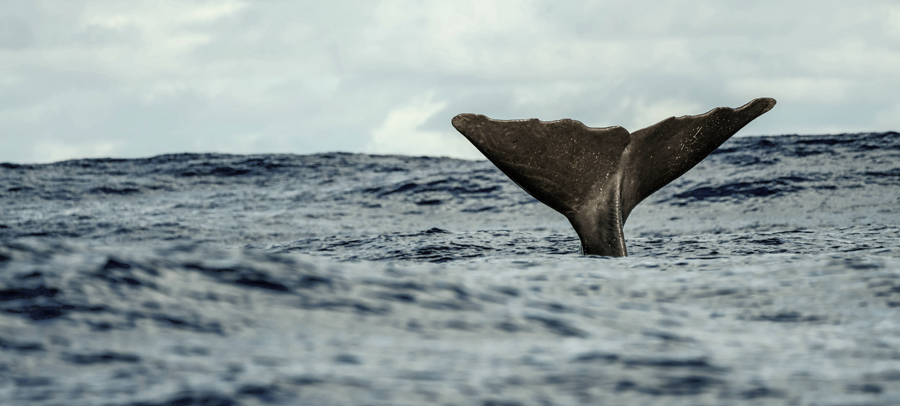
Image credit Susanne Jutzelersuju
The Sperm Whale is the second deepest diving mammal in the world (close runner up to the Cuvier's beaked whale) and reaches depths of up to 2.4k meters (7.3k ft). The whale lifts its flukes (two sections of tail fin) high out of the water as it begins a feeding dive. It has a series of ridges on the back's caudal third instead of a dorsal fin. The largest ridge was called the 'hump' by whalers and can be mistaken for a dorsal fin because of its shape and size. In contrast to the smooth skin of most large whales, its back skin is can be wrinkly and has been likened to a prune by whale-watching enthusiasts.
وتعيش الإناث والشباب الذكور معا في مجموعات بينما يعيش الذكور الناضجون حياة انفرادية خارج موسم التزاوج. وتتعاون الإناث لحماية صغارهن وإرضاعهن. تلد الإناث كل أربع إلى عشرين سنة، وتعتني بالعجول لأكثر من عقد من الزمان. عند الولادة كلا الجنسين هي تقريبا نفس الحجم، ولكن الذكور الناضجين عادة ما تكون 30٪ إلى 50٪ أطول وثلاثة أضعاف الإناث الكبيرة.
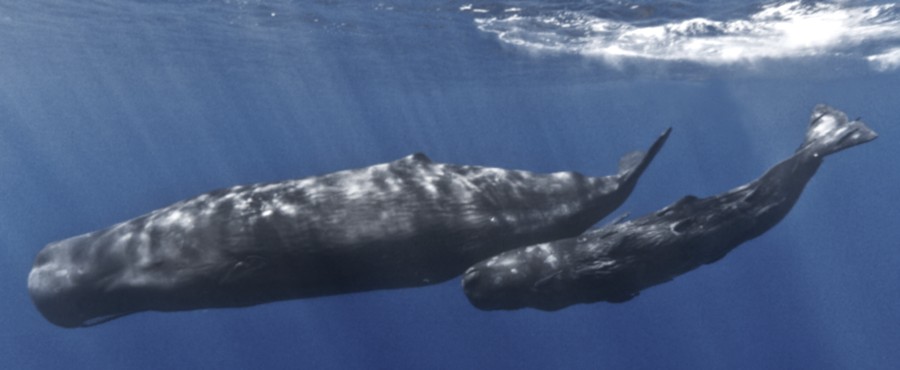
Sperm whales sleep in a unique way, suspending themselves vertically with their heads up towards the water's surface.
Using data-collecting tags suction cupped to 59 sperm whales, researchers from the University of St. Andrews and the University of Tokyo measured (sperm whales) periods of inactivity.
The whales were found to spend seven percent of their day in these vertical sleeping positions near the surface of the water, where they napped from 10 to 15 minutes. Researchers suggested at the time that they might be one of the world's least sleep-dependent animals. (National Geographic.com)
Sperm whales communicate via 'echolocation' - a vocal 'clicking' sound that they send through the water which bounces back once it has made contact with an object, signalling the location of the object to the whale, its size etc.
A mature sperm whale's only real natural predator is the killer whale, who will sometimes try to pick off the smaller calves.
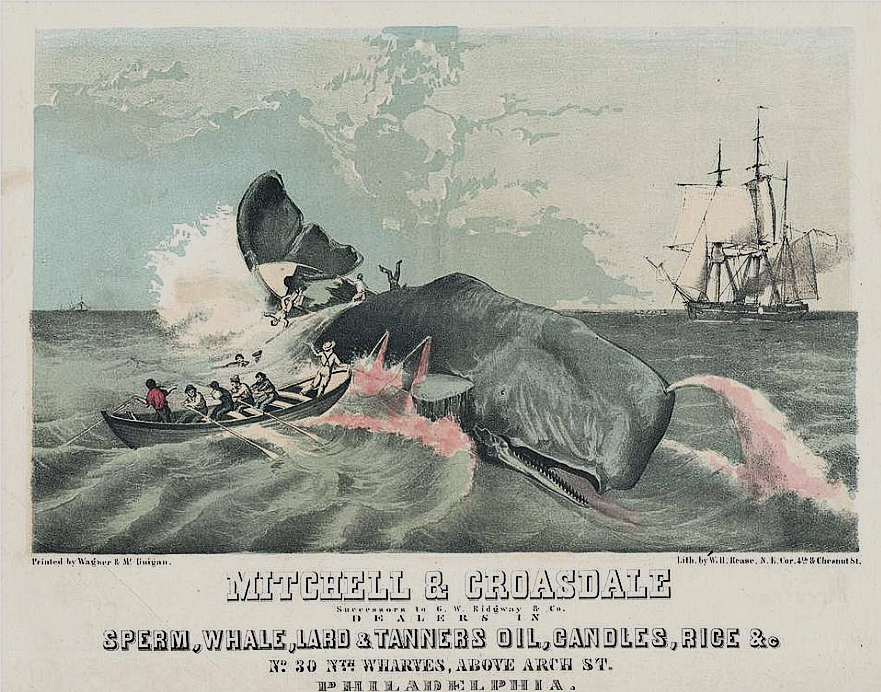
Image credit Philadelphia Museumof Art
The Spermwhale has section at the top-front of its head (a 'case') which holds up to a ton of a thick waxy/oily substance called 'spermaceti' which was widely used as a lubricant, and as an oil to burn in oil lamps or to be fashioned into candles. It is said that this was the product that 'lit London' during the industrial revolution, even the lighthouses around the UK used the oil to light their lanterns!
Sperm whales were a primary target of the commercial whaling industry from 1800 to 1987, which nearly decimated all sperm whale populations. While whaling is no longer a major threat, sperm whale populations are still recovering, with the predicted population at about 844,761 in 2022 (Whitehead, 2022).